

The “Kállos & Sthénos” Philosophy
So, fun fact: the word “calisthenics” comes from two Greek words—kállos (beauty) and sthénos (strength). Pretty cool, right? That’s basically what this whole calisthenics workout plan for beginners is about: getting strong AND looking good while doing it. No fancy gym memberships, no waiting for equipment, just you, your body, and gravity doing its thing.
Here’s what I love about a beginner calisthenics workout—you literally need nothing to get started. Your living room? Perfect gym. The park down the street? Also a gym. That hotel room on your vacation? Yep, gym. Whether you’re totally new to fitness or just looking for something more flexible than traditional weightlifting, this calisthenics routine for beginners has got you covered. It’s all about learning to control your own body, which honestly feels pretty awesome once you get the hang of it.
Why Calisthenics? 5 Unbeatable Benefits
Functional Real-World Strength
Okay, so every movement you’ll do in a calisthenics routine for beginners actually mimics stuff you do in real life. Pushing open that ridiculously heavy door at the coffee shop? Check. Pulling yourself up when you’re climbing? Check. Squatting down to grab something you dropped? Double-check. Unlike those weird isolated machine exercises at the gym that make you stronger at… well, that one specific machine, calisthenics makes you stronger for actual everyday stuff.
Freedom & Flexibility
This is honestly my favorite part. Your calisthenics workout plan for beginners goes wherever you go. Backyard workout at sunrise? Do it. Lunch break session at the park? Absolutely. Stuck in a hotel room at 11 PM? No problem. The “I can’t get to the gym” excuse? Yeah, that one doesn’t work anymore.
Cardiovascular & Weight Management
When you set up your beginner calisthenics workouts as circuits (basically doing exercises back-to-back with minimal breaks), your heart rate shoots up while you’re building muscle. It’s like getting two workouts in one, which is pretty efficient if you ask me. A lot of people find this super helpful when they’re trying to manage their weight.
Mental Well-being
Look, I’m not gonna lie—finishing a tough workout just hits different. Most people who do this regularly say they feel way better mentally, less stressed, and just more confident overall. There’s something about finally nailing a move you’ve been working on that makes you feel like you can conquer anything. That confidence? It spills over into everything else you do.
Joint Health & Mobility
Here’s the thing about calisthenics versus lifting heavy barbells: you’re way less likely to trash your joints if you mess up a form a little. Everything’s about controlled movement through your full range of motion, which means you’re strengthening all those tendons and connective tissues that keep your joints happy. Over time, you’ll notice you can just… move better. And trust me, that matters way more than you think.
The Calisthenics “Skill Tree” Framework
Think of your progress like leveling up in a video game (because why not make it fun?). You start with the basic moves—that’s your foundation—and gradually unlock cooler, more impressive variations as you get stronger. A regular push-up eventually becomes an archer push-up, and if you stick with it long enough, maybe even a one-arm push-up. Every rep you do, even the super basic ones, is helping you unlock the next level.
The 3:2:1 Rule
Here’s how I’d structure your week: three days doing your actual beginner calisthenics workout (the strength stuff), two days doing active recovery like yoga or stretching (your muscles will thank you), and one day to just chill, review your progress, and rest completely. This keeps you from burning out while still making steady gains.
The Progressive Pyramid Method
Instead of randomly doing whatever exercises sound good that day (guilty!), try this pyramid thing. Start each exercise with more reps at an easier version, then do fewer reps at a harder version. Like: 15 push-ups against the wall, then 10 regular push-ups, then 5 push-ups with your feet elevated. You’re building endurance AND strength at the same time, which is pretty smart.
Essential Gear: From Zero to Pro
Level 0 (No Equipment)
You can literally start your calisthenics workout plan for beginners with nothing. Zero. Zilch. Just some floor space. Got a sturdy table? Boom, that’s your anchor for rows. Got a wall? That’s your support for push-ups and handstand practice. This is probably the most accessible fitness method on the planet.
Level 1 (The Basics)
Once you’re hooked (and you will be), three things are totally worth getting: a decent exercise mat (your knees and elbows will appreciate this), a pull-up bar you can mount in a doorway, and some resistance bands. These aren’t required at first, but they make everything so much better.
Level 2 (The Upgrades)
If you get really into it, you might eventually want parallettes (basically small parallel bars that save your wrists), gymnastic rings (these are insanely good for building stability), and some liquid chalk for better grip. But honestly? Don’t worry about these until you’ve been at it for a while.
The 7 Foundations: Mastering Form (with Form Cues)
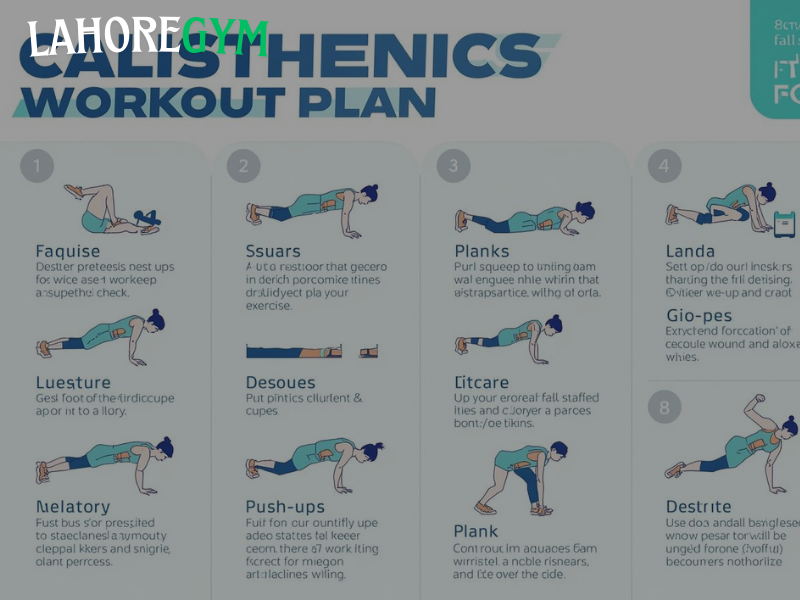
1. Push-ups
Drop down until your chest almost kisses the floor, keeping your elbows at about 45 degrees from your body. Squeeze your core like someone’s about to poke you in the stomach. Think of it as a moving plank, not just an arm exercise.
2. Inverted Rows
Get under a table or low bar, keep your body straight as a board from your heels to your head. Pull yourself up by squeezing your shoulder blades together like you’re trying to crush a grape between them. Your chest should touch the bar.
3. Bodyweight Squats
Start by pushing your butt back like you’re about to sit in a chair. Keep your chest up, weight in your heels. Your knees should point the same direction as your toes—definitely don’t let them cave inward (that’s a recipe for problems).
4. The Plank
Make a straight line from your head to your heels. Don’t let your hips sag down or stick up in the air (both are super common mistakes). Squeeze your butt, brace your core, and try not to hold your breath even though you’ll want to.
5. Lunges
Step forward and drop down until both knees are at 90 degrees. Your front knee should stay behind your toes, and keep your torso upright. Push through your front heel to stand back up.
6. Dips
Whether you’re using parallel bars, chairs, or a bench, lower yourself until your upper arms are parallel with the ground. Lean forward a bit for more chest work, or stay upright for more tricep focus. Whatever you do, don’t just drop into the bottom—control it.
7. Pull-ups
Start from a complete dead hang with straight arms. Pull until your chin clears the bar, using your back muscles more than your arms. No swinging or kipping (yeah, I see you trying to cheat). Strict form is what builds the foundation.
The 30-Day Transformation Blueprint
Week 1: Building the Foundation
Your first week is all about getting the movements down without worrying about looking impressive. Do wall push-ups instead of floor ones, use a high table for rows, and stick with basic squats. Aim for 3 sets of 8-12 reps for each exercise, rest about 90 seconds between sets. I know it seems easy, but you’re teaching your body the patterns it needs to know. Trust the process.
Week 2: Increasing Volume & Intensity
Okay, now we’re talking. Bump it up to 4 sets of 10-15 reps. Start doing circuits where you go from one exercise to the next with barely any rest, then recover for 2-3 minutes before doing it all again. This is where you’ll really start feeling it—and I mean that in a good way.
Week 3: Introducing Dynamics & Variations
Time to spice things up! Add some jump squats for explosive power, mountain climbers for that cardio-core combo, and try assisted pull-ups with a resistance band. Your body adapts to whatever you throw at it, so switching things up keeps you progressing instead of plateauing.
Week 4: Peak Performance & Testing
Final week! This is where you push hard and then test yourself. Do AMRAP tests (As Many Reps As Possible) for each exercise to see how far you’ve come. Write those numbers down—you’ll be shocked when you look back at where you started.
Nutrition & Recovery: Fueling the Machine
The Protein Target
So protein is kind of important for building muscle (shocking, I know). A lot of people shoot for about 1.6 to 2 grams per kilogram of bodyweight each day. If you weigh 70kg (about 154lbs), that’s roughly 112-140 grams spread throughout the day. Think lean meats, fish, eggs, beans, dairy—the usual suspects.
The Calorie Balance
What you eat depends on what you want. Trying to build muscle? Eat a bit more than you burn—like 200-300 extra calories. Trying to lose fat? Eat a bit less—maybe 300-500 calories under maintenance. Track what you eat for a couple weeks to figure out your baseline, then adjust from there.
Sleep & Restoration
Real talk: sleep is when the magic happens. Most fitness folks suggest getting 7-9 hours of quality sleep every night. A lot of people find that when they skimp on sleep, their workouts suffer and they just feel blah. Your body needs that downtime to recover and get stronger.
Tendon Health
Here’s something nobody tells beginners: your muscles get stronger way faster than your tendons do. If you go too hard too fast, you can end up with some gnarly overuse issues. Do your reps slowly and controlled instead of rushing through them. Your tendons need time to catch up, so be patient. Future you will be grateful.
Beyond 30 Days: The 3-Month Roadmap
Month 2: Foundation Reinforcement
After your first month, start adding pike push-ups for shoulder strength and dips for triceps and chest. Make your squats harder by slowing them down or pausing at the bottom. Keep working on those pull-ups—try using less band assistance or cranking out more reps.
Month 3: Advanced Isolation and Skills
Now for the fun stuff! Work on handstand holds against a wall, practice L-sits (these will humble you, trust me), and try pistol squats (single-leg squats that look way easier than they are). These are the moves that’ll make people stop and watch.
FAQ: Common Beginner Obstacles
How long should sessions be?
Most beginner calisthenics workouts run about 30-60 minutes including warm-up and cool-down. Honestly, a solid 40-minute focused session beats a distracted hour-and-a-half session every time. Quality over quantity, my friend.
What if I can’t do a single pull-up?
Join the club—most people can’t at first! Start with negative pull-ups (jump to the top, then lower yourself super slowly) or use resistance bands for assistance. You could also do inverted rows instead. Stick with it, and eventually you’ll get that first real pull-up. It’s an amazing feeling.
Is it okay to train with muscle soreness?
Mild to moderate soreness (DOMS—Delayed Onset Muscle Soreness) is totally normal and you can work through it. But if you’ve got sharp sensations, joint weirdness, or stuff that gets worse when you warm up, that’s your body saying “hey, maybe chill for a day.” Learn the difference between good muscle fatigue and “uh oh, something’s wrong.”
Can I combine this with cardio?
Absolutely! Throwing in 2-4 low-intensity cardio sessions per week (walking, biking, swimming) can complement your training nicely. Just maybe don’t do intense cardio on the same days as your strength work—your body needs time to recover between beatings.
Tracking Your Legend
Look, starting this calisthenics workout plan for beginners is about way more than just getting fit. It’s about proving to yourself that you can commit to something and see it through. And here’s the secret: consistency beats intensity every single time. Someone who trains three times a week for a year will absolutely destroy someone who goes crazy for three weeks then quits.
Here’s your homework: Do a baseline test today. How many perfect-form push-ups can you do? How long can you hold a plank? Write it down. In 30 days, test again and prepare to be impressed with yourself. In 90 days, you won’t even recognize your old capabilities.
Your body is the only one you get for your entire life, so you might as well learn to use it properly. This isn’t just about building muscle or losing weight—it’s about taking control and proving that change is always possible, no matter where you’re starting from.
The best time to start was yesterday. The second-best time? Right now. So grab your phone, log that first workout, and let’s do this thing.
Disclaimer: This content is for informational and lifestyle purposes only. Before beginning any new exercise program, consult with a qualified healthcare professional or certified fitness trainer to ensure it’s appropriate for your individual circumstances and fitness level.